Tuesday, May 6, 2014

Escape to the Cape

Continuing our journey across Cape Town, on early Sunday morning, David and I boarded a boat for our Big 5 Marine Safari.  

After driving for three hours from Cape Town to Gansbaai, we met our captain and were given a short safety briefing.  This included what to do if the boat capsized, because apparently that happens sometimes.  What?!  I was more worried about falling into shark-infested waters than actually drowning!

The Big 5 of the Sea in SA are the dolphin, whale, African penguin, seal, and Great White shark.  Unfortunately we didn’t see any dolphins or whales, as the waters were too choppy and it wasn’t really whale season, but we spotted the other three.

And lots and lots of birds!

First up were the African penguins on Dyer Island.  The African penguin is also called the Jackass penguin because of the donkey-like braying sound it makes.  The penguin population here has greatly decreased in the last 100 years due to increased fishing and the removal of guano to use as fertilizer.  The penguins used to nest in the guano, but now they are completely exposed to the elements and predators.


To help out the little guys, David and I purchased some real estate on Dyer Island – a cozy little abode for a penguin and its family.  


These dog-house looking structures are used by the penguins to keep comfortable while nesting, and shield their young from birds while the parents hunt for food.

In South Africa, seeing a Great White shark is practically guaranteed.  The waters between Dyer Island and Geyser Rock are known as Shark Alley because the Great Whites patrol the channel in the hope of catching one of the 60,000 seals that inhabit the area.

So many seals!  
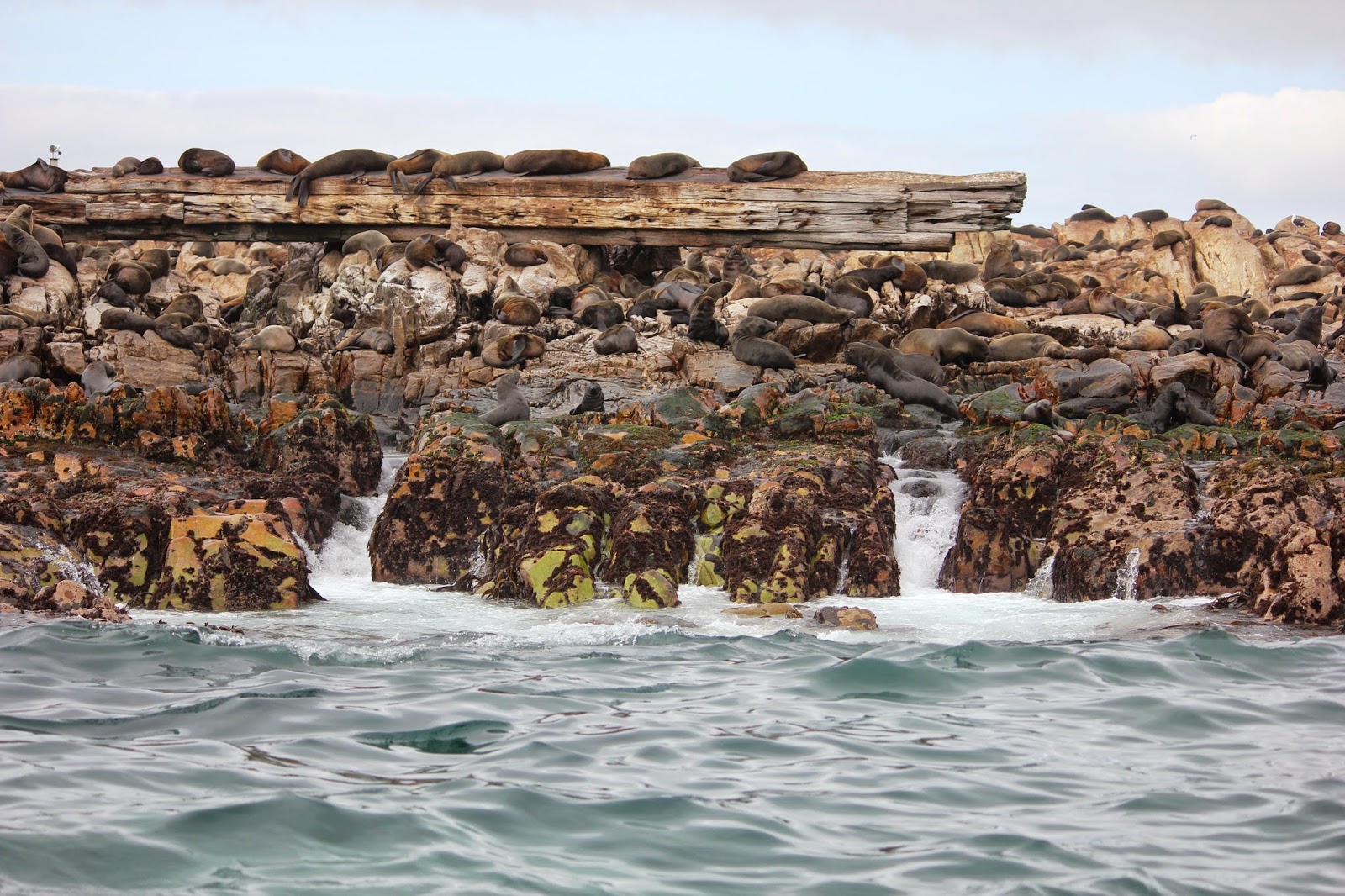
Some were playful, watching our boat and swimming around us.  Others were sleepy and stayed on Geyser Island, sunbathing on the rocks or this plank of wood from an old shipwreck.

The sharks weren't hungry on Easter morning, and did not go on the hunt for seals while we were out, but we were able to catch up with a cage-diving boat, and the sharks were all over that area!  We saw a few circling the boats beneath the waves, and they were just as huge and terrifying as we imagined they would be!  The largest one we saw was about 10 feet long and could've easily swallowed me whole!


After the marine safari, we drove back along the coast to Cape Town.  As we briefly stopped in Hermanus, I felt like I was in California again, but this time at a sunny beachside town.  Hermanus was beautiful – full of quaint rental cottages, outdoor cafes, and scenic views of the sea.  In the summer months, whale watchers flock to this area of the coast.  The animals often come so close to shore during mating season that boats aren't necessary to do any whale-watching. 

We continued our tour of wild Africa on Monday with a drive around the Cape.  We started off at Cheetah Outreach in Somerset West. 


The cheetah population in South Africa is under threat.  Farmers are setting traps and killing cheetahs and other wild animals to protect their livestock.  In order to educate the farmers and prevent unnecessary deaths, the outreach facility breeds Turkish Anatolian Shepherds to place on farms.  Cheetahs do not like confrontation, so the dogs will scare them away.  Hand-raised cheetah cubs are also raised at the center, and travel all over the world to act as ambassadors.


David and I arrived hours before the complex opened to walk two of the cheetah cubs.  This was a really special opportunity, and we were treated with a behind-the-scenes look at how the animals are cared for. 

You are probably asking yourself, ‘How do you walk a cheetah?’  We found that it’s like walking Kirby, but even trickier.  They are huge, even the cubs, and incredibly powerful and fast.  They do pull on the leashes, and because they are so fast, carers are stationed around them with bowls of raw meat and toys to distract them, or tempt them back if they try to run away.  Luckily, there were no incidents while we were there.  It turned out to be a fun walk with a couple of rambunctious nine-month-olds.

This one kept staring down David.  We think it was confused by the Go-Pro.

During the walk, the cheetahs would often just plop down on the ground for a rest (they are lazy cats, after all).  At this time, David and I were invited to get up close and personal, and even pet them. 

After walking two of the cubs, we met Uncle Joe, a twelve year old cheetah.  We were able to compare the difference in the bodies and fur of the adults versus the cubs.  The adults were much leaner, and their hair was softer.  And their claws were huge!  The cubs had coarser fur because of their baby scruff and less oils, and of course their nails were not nearly as long.


We were also able to meet a few other small predators living at Cheetah Outreach, including a couple of jackals, some meerkats, a serval cat, a caracal cat, and a family of bat-eared fox.

I didn't think I'd ever seen a caracal cat before.  Its ears looked like horns from further away.

From there, we drove along the sea, past a township that stretched for miles, and then through various coastal towns to Boulder Beach to watch the African penguins waddle out of the ocean and rest in the sand.


They were so adorable!  I wanted to take one home with us!

Then it was off to the Cape of Good Hope Nature Reserve.  Here, we were greeted by a few friendly baboons before taking the funicular called the Flying Dutchman to the top of Cape Point.  We took in the views, snapped some photos of the lighthouse, and then drove back through the reserve.


On our way back to Cape Town, Riaz from GoCabz took us on a fantastic tour of the cape and its beautiful beach towns.  We did the Chapman’s Peak Drive, which is considered one of the most scenic roads in the world.


After a long day, we entered Cape Town from Camps Bay and Clifton Beach, as the sun was setting over the 12 Apostles.


On our final day in Cape Town, we wandered through the city.  We walked from the waterfront up Long Street, which reminded us of New Orleans with its eclectic mix of hotels, restaurants, and shops.  We strolled through the Company Gardens past a number of museums, and then circled back down Government Avenue to the Castle of Good Hope, built in the late 1600s by the Dutch East India Company as a military stronghold.


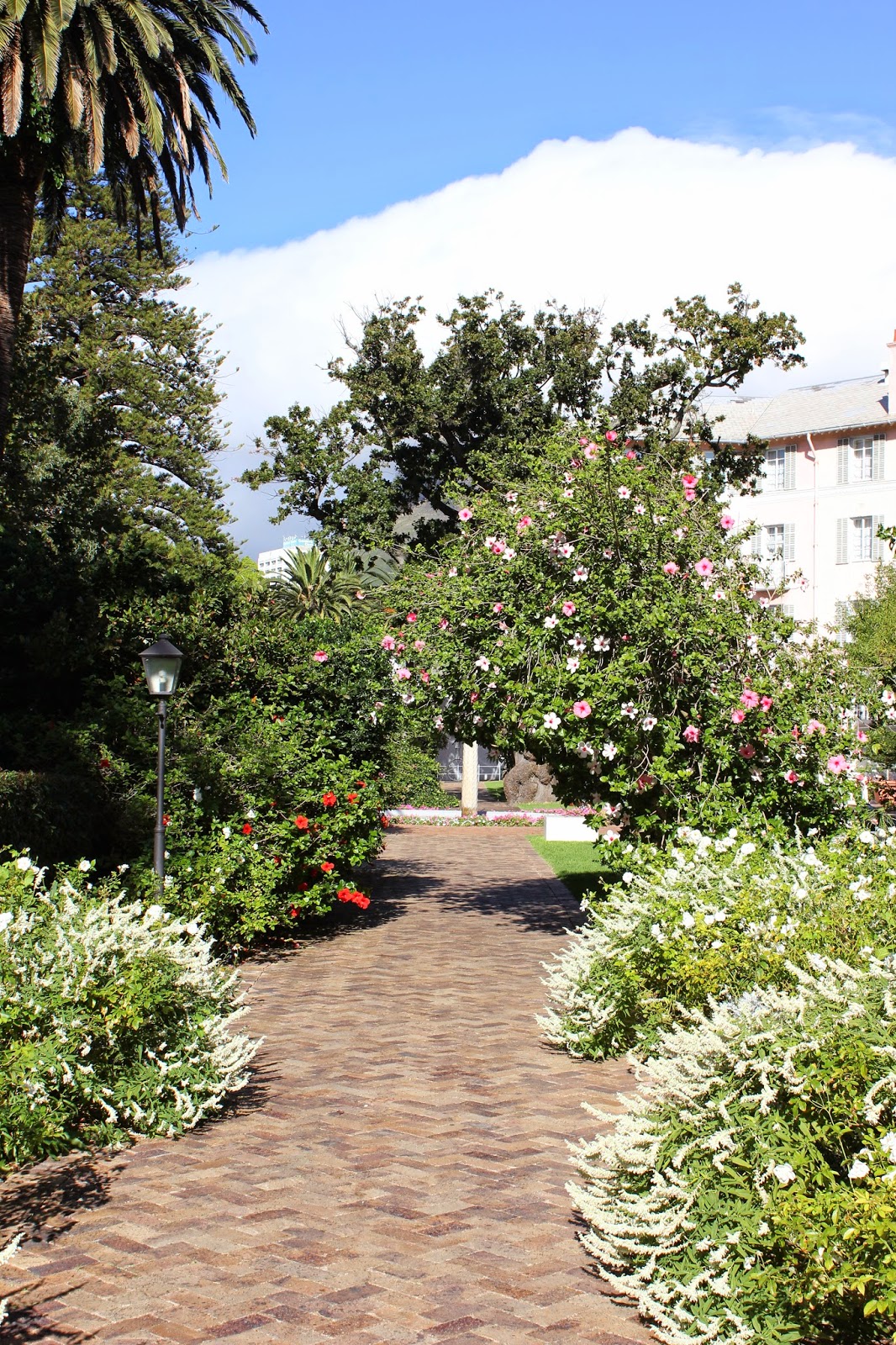
After making our way back to the Westin, we quickly changed into nicer clothes for our afternoon tea booking at the Mount Nelson Hotel, otherwise known as the Pink Palace.  We felt like early explorers in the historic hotel, enjoying our tea in the gardens in the shadow of Table Mountain.  It may seem silly to go to afternoon tea in South Africa, coming from London, but the Mount Nelson afternoon tea was recently voted best in the world. 


We drank the Mount Nelson blend, and were free to help ourselves to the savory and sweet goodies laid out on a huge banquet table in the tea room.  The table was full of our usual favorites – tea sandwiches like rare roast beef with rocket, cream cheese and cucumber, and scones with clotted cream and jam.  But there were also some new goodies to try like samosas stuffed with savory mushrooms, quiche, Sacher torte, angel food cake, and the local delicacy, milk tart. 


It was the perfect ending to a perfect trip.  Cape Town is an amazing city, so it was easy to see why the New York Times named it the #1 travel destination for 2014.  Our only regret was that we didn’t have more time to spend there.

Wednesday, April 30, 2014

Good Friday at Good Hope

We hope everyone had a wonderful Easter this year!  To celebrate and take advantage of the bank holidays, David and I headed south to Cape Town.


Though we were travelling from the top of Europe to the bottom of Africa, the flight was not bad.  We were able to fly direct on a BA 747 (my first time on a double-decker plane!) and the time difference between London and Cape Town is only one-hour.  So we ended up getting 8 hours of sleep on the 11 hour flight, waking up refreshed in South Africa when we landed at 9:00 Friday morning.

Instead of taking it easy that first day, we hit the ground running, or should I say hiking.  On Friday afternoon, David and I decided to climb to the top of Table Mountain via the India Venster route.  We wanted to do something a bit more adventurous than the tourist trail, Platteklip Gorge, but I don’t think we really knew quite what we were getting ourselves into… 


We’d read reviews of the route and knew it would be a bit steep, so we hired a mountain guide, and we were glad we did!  Our first indication that India Venster was no joke came as we landed and were chatting with the man in the seat next to us on the plane.  When I told him our plans for the day, he replied, ‘Oh, you two must be rock climbers.’  Uh, what?  Then our cab driver from the airport to the hotel told us that one of his charges died from a fall on India Venster a couple of years ago.  Ohmygosh!  What had we gotten ourselves into?

The trail started off easy enough directly under the cable car.  Hendre, our guide, was full of energy and enthusiasm.  She began hiking up the rock steps through Phase I at a pretty fast pace, and only later, when we finished in two hours instead of the recommended three and a half, did I realize how fast we were going.  After the first section, we took a breather and then the three of us split off to India Venster on the right, while all of the hikers behind us headed to the Gorge.


During Phase II, we began scrambling up boulders to get higher and higher.  At the end of this unit, Hendre pointed to a group of people dangling off the side of the mountain above us and stated, ‘That’s where we’re headed next!’  David turned around and asked me, ‘What did you sign us up for?!’  But it was too late to turn back at that point.  We had climbed too far and we were too scared to try going back down.


It was terrifying at some parts, but Hendre was an excellent guide and helped us through all of the difficult parts.  She told us exactly where to place our hands and legs, and even made foot-holds for us when there were none.

When we finally reached the summit, we felt so accomplished.  We had made fun of the lazy people taking the cable car up the mountain, but by the time we got to the top, we were begging Hendre to let us take it back down.  And she agreed! 

I love how the foot indicating the trail is painted straight-up on this rock.  Who do they think we are, Spiderman?

David and I had never used staples or chains before, but we were so glad they were there.  Looking back at the description of the trail now, I realize it does specify Grade B scrambling.  Because I didn’t know what that was at the time, I ignored it when I signed us up.  Oops! 

The view from the top of Table Mountain was stunning.  And the view from the cable car going back down was even better! 

When we got to the top, the wind was blowing the clouds up over the mountain, and then dissipating before hitting the city below.  South Africans call this cloud-bank the ‘tablecloth.’

That evening, we had dinner with our friends, Laura and Kelli.  We joked that Laura was stalking us because she just happened to be in Cape Town during the same weekend (just like in Iceland).  We found out a couple of days before we left that not only were she and Kelli on the same BA flight, too, but they were also staying at the Westin at the V&A Waterfront.  What a coincidence!

Laura found a great restaurant called the Harbor House on the V&A Waterfront.  I knew I would be getting my fair share of seafood while in Cape Town, so I opted for the beef fillet that night.  David and Laura had the yellowtail and Kelli chose the prawns. 

Too many prawns! 

I couldn’t believe she finished that entire plate (with some help from the rest of us).  For dessert, we couldn’t decide, so we ordered the lemon tart with a caramelized sugar crust, the dark chocolate terrine, and the yogurt panna cotta to share.

All of the food in South Africa was amazing.  Of course, being on the water, seafood dominated every menu, but the variations were so great that we never got bored. 

The Westin had a huge breakfast buffet every morning featuring a waffle station, bread and pastry table, hot options like potato rosti and bacon and eggs, an Asian section with noodles and sushi, and a smoothie bar.  I thought it was even better than the Maldives, but David said that was blasphemy. 

The evening after Harbour House, we had dinner at Baia, one of the best seafood restaurants in Cape Town.  We split a lobster and asparagus starter and then David had baby Kingklip (that turned out to be one big baby!) as his main.  As it’s currently Fall in South Africa, I had the pear and Roquefort salad and butternut squash soup with sage butter, parmesan, and pine nuts. 

For Easter dinner, we ate at Panama Jack’s.  Our driver, Riaz, made the recommendation, but warned us that the location is a bit strange.  As we drove to the waterfront and had to pass through security, we realized the restaurant is in the dockyard.  Situated between cargo crates and heavy machinery, the restaurant is a favorite with locals, including the shipyard workers, and tourists alike.

I started our Easter meal off with vegetarian spring rolls, while David had an oyster shooter with tequila and hot sauce.  You know, a typical Easter Sunday meal…  

David chose his own lobster from the tank and it was served with rice and a trio of sauces, while I had the lobster saganaki – marinated with Indian spices and pan fried with garlic before being topped off with feta and cilantro.

Sushi is also hugely popular in Cape Town and the surrounding areas.  During our tour of the Cape of Good Hope, we had lunch at the Two Oceans Restaurant at Cape Point.  We weren’t expecting much, as that area is so touristy, but Two Oceans was a pleasant surprise.  We had rainbow rolls, shrimp tempura with peanut sauce, and shrimp with special mayo.   Then we split a platter of Mozambique langoustines with warm lemon butter.


Our final meal was at Willoughby & Co., a trendy restaurant actually inside the mall at the V&A.  As we were waiting in line to be seated we were offered free glasses of local wine.  For our last meal, I had the shrimp gyoza and a couple of rolls, but David had finally reached his seafood threshold and ordered the steak marinated in teriyaki sauce with skewered veggies. 


As a testament to how delicious every meal was, I came back to London to discover I had gained three pounds while on holiday!  Eek!  (But it was worth it.)

The food wasn’t the only great culinary experience.  On Saturday, we had planned a relaxing day in wine country.  We didn’t want to drive, as we knew we would be drinking a lot of wine, so we went with a small group of people through a tour British Airways organized.  The group consisted of us, our driver, Ivan, a couple from Sweden and France, and a family from Israel.


South Africa’s wine country is made up of beautiful farmland just outside Cape Town.  Bordered by lush mountains, the farms are in the traditional Dutch style and date back to the early 19th century.  I told David as we were driving through the area that you could drop me in the middle of one of these vineyards or quaint towns and I wouldn’t know whether I was in Napa or Cape Town. 


Our first stop was Zevenwacht just outside Stellenbosch.  As we pulled up around 10:00, the tasting room was full of winos, enjoying their glasses with a breakfast of cheese and crackers. 


The pours were not samples by any definition.  They were full-on glasses of wine.  And the prices were incredible.  For $2, we were offered a sample of 5 wines.  And for $5, we were offered a sample of 9 wines.  That’s 9 glasses of wine for $5!  Unbelievable!  David and I ended up buying two bottles later in the day, along with some cherry-flavored dark chocolates and the total price came out to $11.  $11!

From Zevenwacht, we drove to Stellenbosch and strolled through the picturesque town, window-shopping and taking photos.  Then we drove to Franschhoek for lunch at an outdoor pizzeria featuring live music.  After eating, we walked through the Saturday market set up in the churchyard, before heading to our next winery.


On the way to Paarl, we passed Victor Verster Prison, where Nelson Mandela was held under house arrest during the last fourteen months of his imprisonment.  Unfortunately, during our trip, we did not have time to visit Robben Island, but we urge anyone going to Cape Town to book your ferry tickets in advance.  The tours are currently being conducted by former political prisoners, so the opportunity to hear the stories first-hand and see the prison with them is not to be missed.


In Paarl, we stopped at Laborie, where David and I purchased a bottle of white and a bottle of rose.  The sauvignon blanc was delicious, and really refreshing as the day was starting to heat up.  Fall in South Africa is like Fall in Texas – it doesn’t actually get that cold. 

Then it was off to Marianne, where they pair their wines with biltong, or jerky.  They offered springbok, kudu, and beef.  

I was hesitant to try the local meats, especially the springbok (it’s the national animal of South Africa, for goodness sake)!

But actually, kudu was my favorite, even more so than beef!

And finally, we made our last stop at Vergenoegd, a family-owned winery that also breeds show ducks.  I didn’t even know that show ducks were a thing, but their signature wine is called Running Duck and is shipped all over the world.  Every morning, they run the ducks through the rows and rows of vines as a natural pest control.  The grounds were beautiful, and we were glad that we had taken a day to relax and see some of the countryside.


Monday, April 14, 2014

Gorillas in the Mist

The main reason for visiting Uganda was the chance to track apes – the chimpanzees and gorillas.


While we spent the majority of our time at Queen Elizabeth National Park on game drives or viewing the wildlife around the Kazinga Channel, we did spend one morning tracking chimps in the Kyambura Gorge.


The Kyambura Gorge is 16 km long and 100 meters deep, carved out of the landscape by the Kyambura River.  It is home to two dozen habituated chimpanzees, which means that the chimps have had contact with man and will carry on with their daily lives even in the presence of humans.  They are known as the lost apes, because this is the only area of QENP containing primates.  All other chimps have moved on to other areas of Uganda, like the Bwindi Impenetrable Forest or Kigale National Park.

We arrived at Kyambura at 8AM to be briefed by a ranger before beginning our descent into the gorge.  While we were on our way to the entrance, we just happened to stumble upon a chimp picking fruit from a tree along the top of the ridge!  And nearby, we spotted a group of Black and White Colobus monkeys.  Even though we knew that it would be difficult to find only a handful of chimps in the massive gorge, we were hopeful once we saw that one.  Little did we know that Kyambura translates to, 'I searched, but I could not find.'

Before starting the hike, we had been warned it would be tough, but feasible.  After meeting our ranger, scout, and protector (a woman named Dina carrying a very large gun), we made our way carefully to the edge of the gorge, where we were met with a set of very steep steps leading into the darkness below. 

Here, five people on the trek immediately gave up and got back inside their vehicles.  The hike down into the gorge was just too steep for them.  David, who I must remind you is afraid of heights, bravely led the charge and was the first down into the gorge.  I followed, with Karen behind me.  And honestly, that was one of the easiest parts of the day.


We spent three hours in the ravine, and the hike was treacherous.  We crawled over and under fallen trees, balanced precariously on tiny ledges overlooking a sheer drop to the rocky river below, and held on for dear life to roots as we climbed up out of the gorge.  Poor Karen thought she had her balance at one point, but lost it, and began to slide down the hill on hands and knees.  Luckily there was a sweet German woman behind her, who grabbed her bum, and pushed her up.  David, meanwhile, had been standing at the top laughing hysterically at her.  What a good son!  But no, he really did help her every other step of the way.  I had already made it to the top with the scout (I found running up easier than taking slow, unsure steps).  When Karen emerged covered in mud, I couldn’t help but exclaim, ‘Ohmygosh what happened to you?!’

Thank goodness we didn't need to cross this bridge!

And after all of that, we did not see a single chimp apart from the one before we started our hike.  But we looked on the bright side – 1) we were on vacation in Uganda, 2) we had just spent three hours hiking in beautiful terrain covered in lush greenery, and 3) we were lucky to see one chimp having its breakfast at the top of the rim.


We were not lucky on our last day in QENP as we drove from Ishasha to Bwindi Impenetrable Forest, either.  We did not find any tree-climbing lions in Ishasha.  In fact, the lions hadn’t been spotted for days.  But again, we played the Glad Game – 1) we were on vacation in Uganda surrounded by stunning scenery, 2) we saw plenty of lions at QENP, including two males together (practically unheard of), 3) we saw lots of other animals at Ishasha like hippos, monkeys, and topi, and 4) we weren’t kidnapped or killed by any radicals from the DRC as we enjoyed our lunch at the border!

We knew that we would have better luck at the Impenetrable Forest.  Unlike the chimps, tourists are guaranteed to see the gorillas.  It may take fourteen hours, but the Uganda Wildlife Association has a fail-proof system in place.

First, there are specific families of gorillas in the forest that are habituated.  They can tolerate small groups of people (each trek has a max of 8 participants) around them for up to an hour each day.  Once a family is found, trackers mark the area with their handheld GPS devices.  The next morning, two hours before the group of tourists starts their trek, trackers are sent to the location marked on the GPS from the day before.  Once they reach the area, they use their amazing tracking skills and machetes to get through the forest to find the gorilla’s nest from the night before (as gorillas are stationary during the night).  And from the nest, they follow the current day’s track.  Meanwhile, the tourists are hours behind but catching up fast.  As gorillas can travel many, many miles in the course of one day, it’s hard to tell how long it will take to track them down – anywhere from a couple of hours to fourteen hours!

There are less than 1,000 mountain gorillas left in the wild, and they live only in central Africa, in the forests of Uganda, Rwanda, and the Congo.  A limited number of tracking permits are given out each year, and the prices are increasing.  Our one-day permit was $500/person but in Rwanda, they are currently $750/person, so we knew this was a once-in-a-lifetime experience.

As we made the five-hour journey from Ishasha to Bwindi, we felt that the forest truly was impenetrable.  We drove for hours along dirt roads, swerving to avoid potholes, and literally hitting a cow to move it out of the way.

The scenery began to change from barren African savannah to rich, dark forests and hillsides dotted with tea and coffee plantations.  Finally, we arrived in Bwindi and the Buhoma Lodge.

Gorgeous views of the tea plantations bordering the forest

The lodge is located inside the Impenetrable Forest and prides itself in its sustainability.  The electricity is run off of solar panels, and there are no outlets in any of the rooms.  The food was excellent, and is sourced from the local area.  We felt like we were living a Swiss Family Robinson lifestyle in our very own treehouse!


After a tour of our digs, we walked through the village to meet the locals and purchase some homemade crafts.  We were accompanied on our stroll by the native vervet monkeys.


The generosity of the American people never fails to impress me.  During our first day in Uganda, we heard that Disney’s Animal Kingdom donated two rhinos to the Ziwa sanctuary.  Later, we learned that elephant trenches around Ishasha (to protect crops from elephants) had been sponsored by both Disney and Busch Gardens.  And while driving through larger cities like Kampala and Entebbe, we couldn’t help but notice the HIV / AIDS awareness billboards paid for by US-sponsored programs.

In Bwindi, we met workers at the local hospital that was started by a doctor from California.  Dr. Kellermann and his wife visited Uganda in 2000, and immediately realized that there was a huge need for a local community hospital.  So they returned home, sold their practice, and moved to Uganda to start the Bwindi Community Hospital.

One of the highlights of the trip was visiting the Bwindi Orphanage, which began much like the hospital – by a visiting couple from Sedona, Arizona who started the 501(c)(3) to aid the local children.

Every day after school, the children come together to sing and dance, and share their stories.  David, Karen, and I went to Thursday evening’s performance and met some very special children.  They were full of energy and joy, and so happy to meet a few Muzungu.

The children performed a welcome dance with a few solos, a traditional wedding dance where two boys fought over the bride (which included showing off for the camera), and a gorilla dance. 

After a really special evening in town and a wonderful dinner back at the lodge, it was early to bed because our gorilla trek was fast approaching!

The morning of the big day, we were all well awake before our wake-up calls at 6:30.  I don’t think the three of us slept at all on Thursday night because we were so excited! 

Because there are no phones or TVs in the rooms, we were gently woken up with coffee and tea in bed, delivered to us by the staff of the lodge.

The misty morning gave way to a clear day

From there, we had breakfast in the dining room and filled our backpacks with our lunch boxes and water bottles, also prepared by the attentive staff at Buhoma Lodge.

After an hour-long briefing with the Uganda Wildlife Authority (UWA), we met our guide, Obed.  We learned that we would be tracking the Habinyanja gorilla family that day.  We were so excited when we learned that the Habinyanja have over 20 gorillas, including many young, and one baby.  We met the other hikers in our group – a couple from France, a couple of Iranian Canadians, and a girl from the UK that was in Uganda doing charity work but taking a day off to trek.

Finished with orientation and ready to begin our hike!

Some of the more interesting things learned during our overview with the UWA were:

-   The Habinyanja family has one silverback patriarch, Makara, and he is feisty.  He is a grumpy old gorilla (about 35 years old), and he loves to charge humans to show them who’s boss.  At this point, I got scared.
-   If Makara did charge us, we were to crouch down and remain absolutely still to show him his dominance.  Again, no running allowed.  We didn’t want to become moving targets.
-   No flash on cameras was allowed.  And if we had to sneeze or cough, we had to stifle it and turn our heads.  We were not allowed to make any loud noise while looking directly at a gorilla.
-   We had to remain 7 meters away from the gorillas, but that wasn’t really realistic as the gorillas approach the humans themselves.  Again, if this happened, we were to remain perfectly still.
-   The family would most likely know when our hour with them was up, and at this time, they would probably get up and walk away.  Those gorillas are mighty smart because that is exactly what happened.

So after scaring the hell out of us, it was time to meet our protection rangers, Ignatius and Robin.  Ignatius led the group upfront with his AK-47 while Robin took the back of the pack, also with an AK-47.  They were there to protect us from other humans, like the Congolese and poachers, not the gorillas.

And then there were the porters.  For $15, we were encouraged to hire a porter to carry our backpack and help us up and down the mountain.  At first, I didn’t think we’d need help, but after the chimp trek, we agreed to gladly pay for some extra assistance.  And our porter, a pygmy called Fred, earned every dollar (and then some, as he received a large tip from Karen).

Pygmies were driven out of the forest in the early 90’s when it became a National Park, so this is a way for Fred to return to his homeland each day.  The porters are amazing.  They wear huge wellies to get through the mud, across the rivers, and deep into the forest.  For $300, they will carry someone up the mountain and back down again to see the gorillas.  This gives literally everyone, from the disabled to the elderly, an opportunity to see the endangered gorillas.  I honestly don’t know how they do it because that hike was hard.

We started at a quick pace up the hill into a tea plantation.  From the plantation, we crossed a steep ledge (I also don’t know how the plantation workers pick all of that tea by hand without sliding down the mountain) into the forest.

Once in the forest, it was easier to grip onto trees and roots to get around, but there were definitely a few times when I was thankful that Fred was there to push me up a hill or hold my hand down another.  Some areas were so steep that I had to slide down on my backside.


After two hours, Obed got a call on his radio from the trackers.  They had found the Habinyanja’s nest from Thursday night and were on the current day’s trail.  After another hour, we got the call that the trackers had found the gorillas! 

So it was time to go off of the path and deeper into the woods.  This was by far the hardest part of the walk, so Ignatius and Robin got out their machetes to clear a path for us.  We all fell multiple times, getting snarled in vines, but Fred was always there to help us up and carry us forward.

After another hour, we began to hear the gorillas around us!  We kept climbing higher until a gorilla ran right in front of us!  It came up to Ignatius, got in his face, and then ran off.  I was too busy paying attention to the ground and my footing, so I missed it.  David remarked, ‘Be glad you didn’t see that because it was the scariest thing I’ve ever seen in my life!  That gorilla was huge!’

A few minutes later, we found the trackers.  They were resting in the bush, and pointed out the gorillas below us.  We were instructed to leave our packs and walking sticks with our porters.  We would be going the rest of the way on our own with just the rangers and trackers.

As we began to approach the family, Makara appeared and began to charge at us.  It was so hard to remain still when my body was screaming at me to run as fast as I could in the opposite direction.  The worst part was Makara whooping as he was running.  That sound was terrifying.

Holly, the Iranian Canadian, was so brave.  She kept getting closer and closer, aiming for the best photo possible.  After about 10 minutes of continuously charging us to exert his dominance, Makara finally gave up and took a nap under a tree.

I went all Blair Witch Project in this video (sorry for the f-bomb, Grandma)!

A female with her two young came to lie beside him, and the babies alternated between resting and rough-housing.  The youngest one, a male about 18 months, stayed awake during the entire hour and entertained us with his tree-climbing.  He was very young, so just beginning to learn to climb.  And he was so adorable.  He would fall and the silverback would look up and grunt, but then he’d get right back up again.  He climbed all over Makara and the female.  And meanwhile, there were multiple other gorillas in the trees around us.  We were completely surrounded.


At the 56-minute mark, Makara got up and began to walk away.  I was astonished that his internal clock was virtually on time with our allotted hour.  Obed said to us, ‘C’mon, we still have 4 minutes.  Let’s follow him a bit.’  The silverback was having none of that, so he charged us one last time.  I guess that was his way of saying goodbye, or, ‘Get the hell out of here, Obed.  I’ll see you again tomorrow!’

Even though I was nervous and afraid for much of the hour, I still really enjoyed meeting the Habinyanjas.  Our up-close and personal encounter with the gorillas was a remarkable experience.  It’s so important to continue to visit and study the mountain gorillas to ensure their survival. 


This trip to Africa was so much more than just a safari.  We spent much of the week on-foot, trekking through the forests to find primates and across the savannah hoping not to run into an angry buffalo.  Or on a boat or our Land Cruiser seeking out elephants and lions and Nile crocodiles, and driving through villages to meet outgoing, friendly Ugandans.  It was a true African adventure and something that we will never forget!