This year for our Easter holiday, David and I wanted to do something a little more off the beaten path. We’ve always wanted to visit the lost city of Petra, but when we began researching, we found that there is so much to do in Jordan! And since the country borders Israel, there are a lot of religious sites to see as well, which made it the perfect destination for our Easter break!
David’s mom has always wanted to visit Jordan as well. Sadly, because of all the political instability in the region around Jordan, tourism is super low in Jordan right now. But that means that prices for flights and tours are also super low. So we were able to get a great deal on a 5-day tour for the three of us!
Karen slept over at our place on Wednesday night so we could all head to Heathrow together on Thursday morning.

But once we got to the airport, we had to split up. The flight was overbooked so chaos ensued when we got to our gate. Since David and I are both Silver Star Alliance members and we were flying British Midlands, a United Partner, we were upgraded to first class to make room for everyone. Yes please! But poor Karen got stuck in the back...
I’ve never flown first class on an international flight before and it was glorious! There was welcome champagne, free premium drinks, a three course lunch, extra leg room and fully reclining seats, and personal entertainment systems. David and I were spoiled rotten for our five hour flight to Amman.

We started our tour the next morning when Ahmed, our driver, picked us up. We drove for about an hour and a half to Umm Qais in Northwest Jordan.

Umm Qais was part of the Roman Decapolis, ten important cities on the Eastern frontier of the Roman Empire. In ancient times, when Herod ruled the city, it was said that Jesus drove a demon out of a man into a group of swine which then ran into the Sea of Galilee. From the ruins, we were able to view the Sea of Galilee in Israel as well as Syria.


Because “Jordan is the quiet neighbor in a neighborhood full of craziness” (as our guide put it), this area of the country does not get a lot of Western visitors. We were obviously dressed very differently than the rest of the tourists in Umm Qais, and people were fascinated by us. Children were literally tripping over themselves, staring. We felt like the Kardashians – famous for no reason! One little girl was even bold enough to reach out and stroke Karen’s arm, like she couldn’t believe Karen was real without touching her. We were asked multiple times by different families if they could take pictures with us. We thought it was so odd that we refused each time. But looking back, I regret not taking a few minutes to take those pictures and talk to them. They were so eager to practice their English on us, but we really just wanted to walk around and take it all in alone. But later in the day, two little girls at Jerash asked me my name and when I told them, I also asked them theirs. And you could just tell that it had made their day – they ran off to their mothers and siblings and recapped our quick exchange in excited little voices and kept repeating “Sarah” over and over again. Karen, David, and I talked about it later that night back at the hotel and discussed how differently we may have acted if we had just come from Texas, where it’s common for strangers to say hello and ask how your day is going. I’m afraid we’re turning into those distrusting, snobby Brits I can’t stand.
Lesson learned!
After Umm Qais, we drove back South to Jerash, another one of the cities from the Decapolis. The complex here is huge, but unfortunately it doesn’t receive the same funding that more famous ruins in Jordan, like Petra, receive. So the mosaic floors of the churches built in 400 AD are completed exposed to the elements, some lion heads were stolen from the Nymphaeum, and most of the city is still buried in the hills. And to be honest, before we booked our tour, we hadn’t ever heard of Umm Qais or Jerash. But after being there, we hope it becomes more popular and gets the funding it deserves!


On Saturday, we drove to Madaba to see the famous 6th century mosaic of the holy land in St. George’s Church. The church was built a little over a hundred years ago when the map was discovered. We also stopped at a mosaic workshop set up by Queen Noor, the American woman who married the late King Hussein. She has set up government programs to help disadvantaged and Bedouin women support themselves.


After viewing the mosaics and purchasing some souvenirs, we went to Mt. Nebo on the outskirts of Madaba. This is the mountain where Moses gazed upon the Promised Land before he died.


From the top of Mt. Nebo, we could see Jericho, said to be the oldest city in the world, and on a clear day, it’s even possible to see Jerusalem. At the bottom of the mountain is the lowest point on Earth and was our next destination – the Dead Sea.
The Dead Sea was bizarre. There is so much salt in the water, no fish or other animals can survive... hence the name. The saline content (nearly 9x that of the ocean) also made us incredibly buoyant. David, who usually can’t float at all, was bobbing up and down in the water. I can float, so the weirdest part for me was not being able to swim. I literally couldn’t get my shoulders below the water or keep my legs down. And after floating around for five minutes, I felt like I had just had a full-body dermabrasion treatment. The salt and mud from the Dead Sea is used in cosmetic products to create smooth skin, so we covered ourselves in the black mud, let it dry, and then rinsed off in the sea. And it really does work - we felt like newborn babies! For about $5, we got the same treatment that women pay a small fortune for at high-end spas around the world.

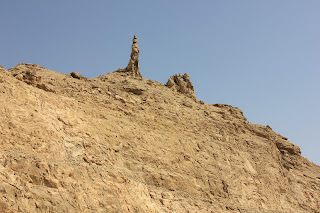
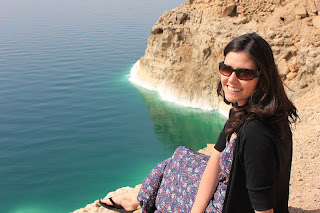
As we drove away along the sea shore, we saw the “Lot’s Wife” pillar and the salt deposits along the rocky shore.
Our final stop before Petra was Shoubak Castle, a Crusader’s Castle that was controlled by Saladin.

The castle has never been fully excavated and the inside is in ruins. So we just admired it from the road before heading to a nearby cave to visit Ali Ababa, another one of Ahmed’s friends. He runs a cave hotel and sells souvenirs from his cave home. It’s hard to believe people still live in caves like that, but we found it was pretty common in Jordan to have a cave or a tent home, like the Bedouins.


On our last day in Jordan, we explored Petra and had a couple of traditional Jordanian dishes for Easter Sunday dinner – mansaf and maklouba. This was the only time we ate outside of the hotels. And like last year in Greece, we ordered the goat speciality, mansaf. I don’t really like goat, so we also ordered maklouba, a popular chicken dish made with khobez (similar to a tortilla) and rice cooked with eggplant, potato, and spices.


Sunday morning, we woke up bright and early to tour Petra. We were so glad we decided to forgo sleeping in to get there right when the site opened at 7AM. There was hardly anybody else there, and the weather was a lot cooler than later in the afternoon. When we left six hours later, most of the tours that had driven in from Amman were just starting and there were thousands of people milling around in the heat.
We met our guide, Ali, a local Bedouin and native to Petra, and then David and I rode horses, Indian-Jones style, to the Siq, a gorge over a mile long that leads to the Treasury. Once at the Siq, we walked the rest of the way through the city.


Petra was the center of Nebataean society; a city carved out of sandstone rock more than 2,000 years ago. It was an important junction on the trade route that linked China and India with Egypt, Greece, and Rome. By the 1400s, it became the “lost city” because the Arabs closed it off to the rest of the world. In 1812, a Swiss traveller re-discovered Petra by tricking the locals into believing he was an Arab from India coming to make a sacrifice at the tomb of Aaron, Moses’s brother.
Because Ali was born and raised in Petra, we could ignore the “No Climbing” signs on the rocks and explore some hidden cave homes and tombs. That was probably the best part of the tour, being away from the crowds, and seeing the site from that high vantage point.


We ended the day climbing almost 1,000 steps to the Monastery, a building used during religious festivals. This building is similar to the Treasury but much less visited because of the difficult climb up the mountain to get to it. However, you can avoid the climb by taking a donkey. It looked too scary though, having no control riding the animal. And we didn’t want to add to their burden. Those donkeys and horses have rough lives, shuttling tourists back and forth in the intense heat.


It’s hard to say what the best part of the trip was because each city we visited within Jordan was so different. From the beautiful landscapes in the North to the deserts and sandstone cities in the South, each day was unique and exciting. And the Jordanians were some of the nicest people we’ve met. Everyone was friendly and welcomed us into their country. To see all of the pictures from our trip, click here.
David’s mom has always wanted to visit Jordan as well. Sadly, because of all the political instability in the region around Jordan, tourism is super low in Jordan right now. But that means that prices for flights and tours are also super low. So we were able to get a great deal on a 5-day tour for the three of us!
Karen slept over at our place on Wednesday night so we could all head to Heathrow together on Thursday morning.

Cuddling with Kirby while we packed
But once we got to the airport, we had to split up. The flight was overbooked so chaos ensued when we got to our gate. Since David and I are both Silver Star Alliance members and we were flying British Midlands, a United Partner, we were upgraded to first class to make room for everyone. Yes please! But poor Karen got stuck in the back...
I’ve never flown first class on an international flight before and it was glorious! There was welcome champagne, free premium drinks, a three course lunch, extra leg room and fully reclining seats, and personal entertainment systems. David and I were spoiled rotten for our five hour flight to Amman.

We started our tour the next morning when Ahmed, our driver, picked us up. We drove for about an hour and a half to Umm Qais in Northwest Jordan.

We expected a desert climate, but Jordan in Spring was beautiful -
rolling green hills and wildflowers were everywhere in the North!
Umm Qais was part of the Roman Decapolis, ten important cities on the Eastern frontier of the Roman Empire. In ancient times, when Herod ruled the city, it was said that Jesus drove a demon out of a man into a group of swine which then ran into the Sea of Galilee. From the ruins, we were able to view the Sea of Galilee in Israel as well as Syria.

Syria

David and his mama in front of the Sea of Galilee
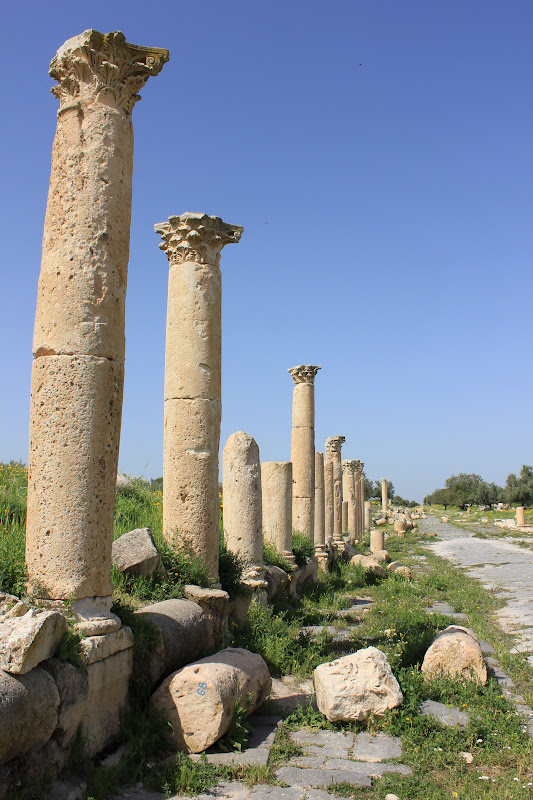
Colonnaded Roman street
Because “Jordan is the quiet neighbor in a neighborhood full of craziness” (as our guide put it), this area of the country does not get a lot of Western visitors. We were obviously dressed very differently than the rest of the tourists in Umm Qais, and people were fascinated by us. Children were literally tripping over themselves, staring. We felt like the Kardashians – famous for no reason! One little girl was even bold enough to reach out and stroke Karen’s arm, like she couldn’t believe Karen was real without touching her. We were asked multiple times by different families if they could take pictures with us. We thought it was so odd that we refused each time. But looking back, I regret not taking a few minutes to take those pictures and talk to them. They were so eager to practice their English on us, but we really just wanted to walk around and take it all in alone. But later in the day, two little girls at Jerash asked me my name and when I told them, I also asked them theirs. And you could just tell that it had made their day – they ran off to their mothers and siblings and recapped our quick exchange in excited little voices and kept repeating “Sarah” over and over again. Karen, David, and I talked about it later that night back at the hotel and discussed how differently we may have acted if we had just come from Texas, where it’s common for strangers to say hello and ask how your day is going. I’m afraid we’re turning into those distrusting, snobby Brits I can’t stand.
Lesson learned!
After Umm Qais, we drove back South to Jerash, another one of the cities from the Decapolis. The complex here is huge, but unfortunately it doesn’t receive the same funding that more famous ruins in Jordan, like Petra, receive. So the mosaic floors of the churches built in 400 AD are completed exposed to the elements, some lion heads were stolen from the Nymphaeum, and most of the city is still buried in the hills. And to be honest, before we booked our tour, we hadn’t ever heard of Umm Qais or Jerash. But after being there, we hope it becomes more popular and gets the funding it deserves!

We entered the city through Hadrian’s Arch,
constructed for Emperor Hadrian’s visit in 129 AD.

Oval Forum

Nyphaeum

Modern-day shepherd tending to his flock nearby. We saw shepherds everywhere we went in Jordan. From the desert to the mountains to the roundabouts in the city centres.
Jordan used to be part of the British Empire, so the locals have adopted and love the bagpipes! There were a few weddings at the hotels we stayed at, and the bride and groom always made their entrance to the bagpipes. In this video, these men are playing in Jerash’s theatre.
On Saturday, we drove to Madaba to see the famous 6th century mosaic of the holy land in St. George’s Church. The church was built a little over a hundred years ago when the map was discovered. We also stopped at a mosaic workshop set up by Queen Noor, the American woman who married the late King Hussein. She has set up government programs to help disadvantaged and Bedouin women support themselves.

Mosaic map of the Holy Land on the floor of St. George's

After viewing the mosaics and purchasing some souvenirs, we went to Mt. Nebo on the outskirts of Madaba. This is the mountain where Moses gazed upon the Promised Land before he died.


View of Israel from the top of Mt. Nebo

Serpentine Cross
From the top of Mt. Nebo, we could see Jericho, said to be the oldest city in the world, and on a clear day, it’s even possible to see Jerusalem. At the bottom of the mountain is the lowest point on Earth and was our next destination – the Dead Sea.
The Dead Sea was bizarre. There is so much salt in the water, no fish or other animals can survive... hence the name. The saline content (nearly 9x that of the ocean) also made us incredibly buoyant. David, who usually can’t float at all, was bobbing up and down in the water. I can float, so the weirdest part for me was not being able to swim. I literally couldn’t get my shoulders below the water or keep my legs down. And after floating around for five minutes, I felt like I had just had a full-body dermabrasion treatment. The salt and mud from the Dead Sea is used in cosmetic products to create smooth skin, so we covered ourselves in the black mud, let it dry, and then rinsed off in the sea. And it really does work - we felt like newborn babies! For about $5, we got the same treatment that women pay a small fortune for at high-end spas around the world.

As we drove away along the sea shore, we saw the “Lot’s Wife” pillar and the salt deposits along the rocky shore.

In Genesis, God destroyed the evil cities of Sodom and Gomorrah after warning Lot and his family to get out. As they fled, Lot's wife disobeyed God and looked back at the city. As punishment, she was turned into a pillar of salt (see above).

We then had to drive from the lowest point on Earth up to Petra. The mountain climb in our van was pretty extreme. We even had to turn off the A/C to guarantee we made it to the top! Once up in the mountains, we saw Dana Valley, part of a huge nature reserve. Our driver also gave us a short break on our 3-hour trip at a friend’s house. All of the Jordanians were so friendly. This man even ran out to the store to get Turkish coffee for us, and came back with goodies to take with us on the road.
Our final stop before Petra was Shoubak Castle, a Crusader’s Castle that was controlled by Saladin.

The castle has never been fully excavated and the inside is in ruins. So we just admired it from the road before heading to a nearby cave to visit Ali Ababa, another one of Ahmed’s friends. He runs a cave hotel and sells souvenirs from his cave home. It’s hard to believe people still live in caves like that, but we found it was pretty common in Jordan to have a cave or a tent home, like the Bedouins.

Us with Ali Ababa

David as Lawrence of Arabia
On our last day in Jordan, we explored Petra and had a couple of traditional Jordanian dishes for Easter Sunday dinner – mansaf and maklouba. This was the only time we ate outside of the hotels. And like last year in Greece, we ordered the goat speciality, mansaf. I don’t really like goat, so we also ordered maklouba, a popular chicken dish made with khobez (similar to a tortilla) and rice cooked with eggplant, potato, and spices.

Mansaf

Maklouba
Sunday morning, we woke up bright and early to tour Petra. We were so glad we decided to forgo sleeping in to get there right when the site opened at 7AM. There was hardly anybody else there, and the weather was a lot cooler than later in the afternoon. When we left six hours later, most of the tours that had driven in from Amman were just starting and there were thousands of people milling around in the heat.
We met our guide, Ali, a local Bedouin and native to Petra, and then David and I rode horses, Indian-Jones style, to the Siq, a gorge over a mile long that leads to the Treasury. Once at the Siq, we walked the rest of the way through the city.

Narrowest section of the gorge

Our first glimpse of the Treasury

Karen and me in front of the Treasury
Petra was the center of Nebataean society; a city carved out of sandstone rock more than 2,000 years ago. It was an important junction on the trade route that linked China and India with Egypt, Greece, and Rome. By the 1400s, it became the “lost city” because the Arabs closed it off to the rest of the world. In 1812, a Swiss traveller re-discovered Petra by tricking the locals into believing he was an Arab from India coming to make a sacrifice at the tomb of Aaron, Moses’s brother.
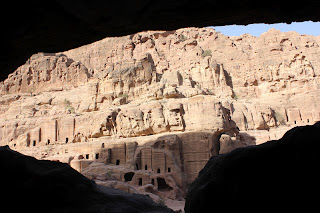
Because Ali was born and raised in Petra, we could ignore the “No Climbing” signs on the rocks and explore some hidden cave homes and tombs. That was probably the best part of the tour, being away from the crowds, and seeing the site from that high vantage point.
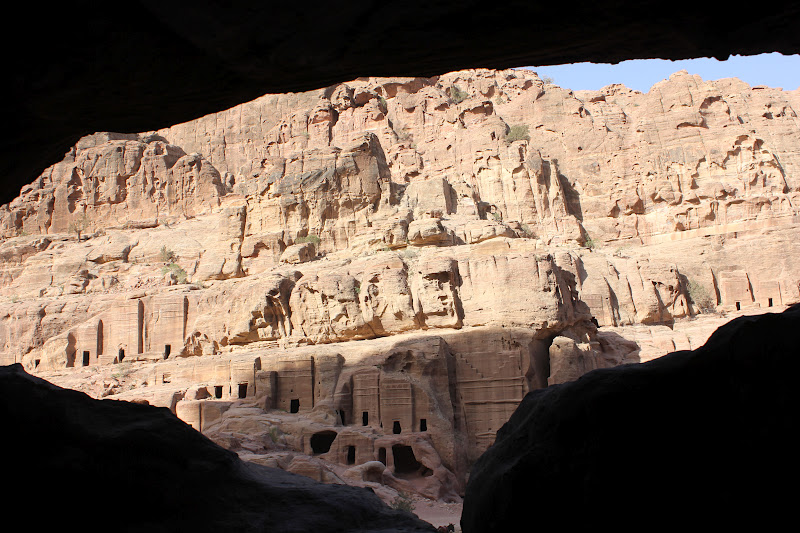
View of the caves from inside a cave


Roman Temple Complex
Those Romans got around – they were everywhere!
We ended the day climbing almost 1,000 steps to the Monastery, a building used during religious festivals. This building is similar to the Treasury but much less visited because of the difficult climb up the mountain to get to it. However, you can avoid the climb by taking a donkey. It looked too scary though, having no control riding the animal. And we didn’t want to add to their burden. Those donkeys and horses have rough lives, shuttling tourists back and forth in the intense heat.

Adorable baby donkeys

Taking a break on our hike to the monastery

The Monastery - well worth the effort!
It’s hard to say what the best part of the trip was because each city we visited within Jordan was so different. From the beautiful landscapes in the North to the deserts and sandstone cities in the South, each day was unique and exciting. And the Jordanians were some of the nicest people we’ve met. Everyone was friendly and welcomed us into their country. To see all of the pictures from our trip, click here.


